You finally took the car out for a real drive. You get home, you walk around it the way you always do, and there it is. A chip in the front bumper. Or worse, the hood.
On a beater, you'd shrug. On a luxury vehicle, your stomach drops — because you know the next move matters.
Here's the honest decision tree we walk every owner through when they bring a chipped car into the shop.
First: what kind of damage do you actually have?
Not all chips are equal. Before you decide what to do, get clear on which category yours falls into.
- Category 1 — Surface scuff or clear-coat-only chip. The clear coat is dinged, but the color coat underneath is intact. You can usually tell because there's no white or primer showing through.
- Category 2 — Color-coat chip. The clear is gone and the basecoat is exposed or damaged. Often visible as a small dot of a different color.
- Category 3 — Primer or metal showing. The chip went all the way through. White primer or bare metal is exposed. This will rust and bubble fast in Florida humidity if it's not addressed.
- Category 4 — Cluster damage. Not one chip, but a peppering — usually across the front bumper or lower hood. Common on cars driven hard on I-95 or behind dump trucks on Kanner Highway.
The category determines what's even on the table.
When touch-up makes sense
A real touch-up — not a paint pen dab — can work on Category 1 and small Category 2 chips, especially on solid-color (non-metallic, non-pearl) paint. The repair fills the chip, gets leveled, and gets sealed.
Where touch-up falls short:
- Metallic and pearl paints rarely match well. The metallic flake orientation in a touch-up never matches the factory spray pattern, so even a perfect color match shows under sunlight.
- Larger Category 2-3 chips leave a visible edge no matter how well it's blended.
- Multiple chips in close proximity look worse touched-up than left alone.
On a luxury vehicle, touch-up is a stopgap. It buys time and stops rust. It does not restore the paint cosmetically to factory.
When respray is the right answer
Respray — repainting the affected panel — is the only true cosmetic fix for serious damage. On luxury paint, that means:
- Color-matching to the factory code (which is harder than it sounds on certain pearls, mica finishes, and special-order colors)
- Spraying the full panel, not spot-spraying
- Blending into adjacent panels so there's no visible edge
- Re-clearing and re-correcting
This is expensive. A repainted hood on a high-end car, done correctly by a body shop that knows luxury paint, runs into five figures. It also creates a paint record on the CARFAX, which affects resale.
Respray is the right answer when the damage is bad enough that you can't live with it and you plan to keep the car. It's the wrong answer for one or two small chips you noticed last Tuesday.
When PPF is the only real answer
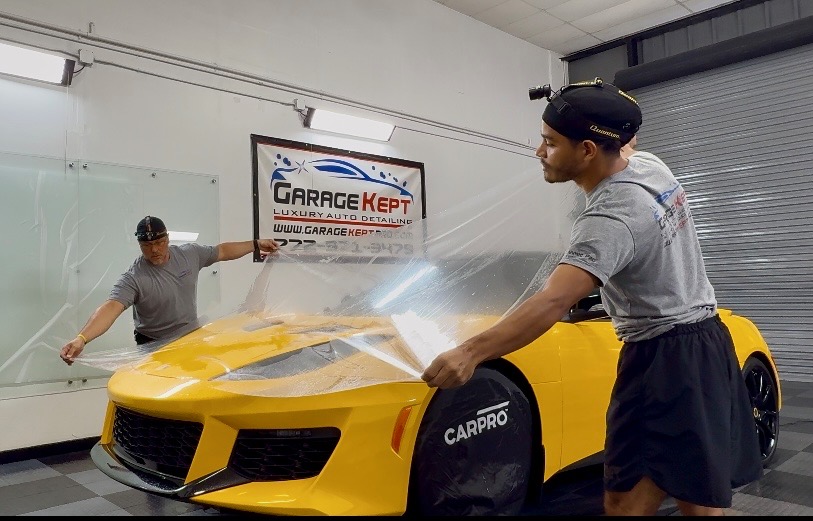
PPF doesn't fix existing damage. What it does is stop the next chip — and the next, and the next.
If the car has Category 4 cluster damage, what you really have is a car that drives in conditions where chips happen often. Respray without PPF means you're back to the same problem six months later.
The right move on a chipped luxury car is usually a combination: respray the worst-affected panel if cosmetics demand it, touch-up the rest as a stopgap, and then full-front PPF (or full vehicle, depending on the car) to make sure you're not back in the same conversation next year.
We've installed PPF on plenty of vehicles with pre-existing chips — the film makes minor damage less visible and prevents new damage outright.
A note on Florida and rock chips
The Treasure Coast and South Florida are particularly hard on front clips. Construction sand on the highways, A1A debris, asphalt resurfacing, and the sheer amount of pickup truck traffic on every road means luxury car owners here lose paint faster than in most of the country. For the bigger picture, see why Florida is so hard on your car's paint.
This isn't a maybe. It's why nearly every high-end vehicle that comes through the shop ends up with full-front PPF eventually. The owners who waited usually wish they hadn't.
What to do if you've got a chip right now
Send us a photo. Text it to (772) 971-3479 along with the car's make, model, and color. We'll tell you honestly what category you're in, whether it needs immediate attention, and what your real options are — touch-up, refer-out for respray, or PPF strategy from here forward.
Call or text Shawn at (772) 971-3479 or request a quote.